It was great to see all the moes for Movember. Yep I joined that. I understand at least as many men die from prostrate cancer as women do from breast cancer. But men do less about it. Beyong blue is also a great cause to support. So thanks all you football moes out their - it reminded me of the 1974 socceroos.
But on a serious note. Do any football players still smoke? A moe isn't enough of a filter if you smoke.
Sunday, November 26, 2006


Sunday, November 19, 2006
What is the story with the referees?
An interesting point. Most of us think that at home games.
Shouting at the ref doesn't seem to work. But makes us feel better.
I suggested to the FFA that they get marquee refs instead of, or as well as, players. The main problem is that, as I understand it, few if any, A-League ref is full time. This means that they do not get the time to reflect on the last match and prepare for the next. For more on this read the world’s best ref, Pierluigi Collina’s autobiography The Rules of the Game (Pan 2003).
In my view Matthew Breeze is the best ref in the A-League, ahead of Queensland and FIFA World Cup ref Mark Shield. Honestly, some of them just are not up to it. What I like about Matthew is that he is not captured by any player and he shows that he has a firm mind of his own on how the game should be played. He is a professional even if this is a part time job for him. If you watch him closely he actually makes very few mistakes. And he gets the big decisions like penalties and red cards right.
I understand refing is a difficult job. FIFA, because of its politics, just will not allow technology to be used to produce a more perfect game. Rugby league has shown how this can be done without affecting the flow of a game. Without the video ref mistakes are going to happen. It is all going on too fast to see everything. However, what I detest and home fans hate, is the old players of the game interfering with the ref. Talking to him, getting him to question his own mind. Plus some of them may be the refs heroes or they may have known them for years. For some older former NSL players this seems to be their main job now. This must be stopped as it brings the game into disrepute.
Shouting at the ref doesn't seem to work. But makes us feel better.
I suggested to the FFA that they get marquee refs instead of, or as well as, players. The main problem is that, as I understand it, few if any, A-League ref is full time. This means that they do not get the time to reflect on the last match and prepare for the next. For more on this read the world’s best ref, Pierluigi Collina’s autobiography The Rules of the Game (Pan 2003).
In my view Matthew Breeze is the best ref in the A-League, ahead of Queensland and FIFA World Cup ref Mark Shield. Honestly, some of them just are not up to it. What I like about Matthew is that he is not captured by any player and he shows that he has a firm mind of his own on how the game should be played. He is a professional even if this is a part time job for him. If you watch him closely he actually makes very few mistakes. And he gets the big decisions like penalties and red cards right.
I understand refing is a difficult job. FIFA, because of its politics, just will not allow technology to be used to produce a more perfect game. Rugby league has shown how this can be done without affecting the flow of a game. Without the video ref mistakes are going to happen. It is all going on too fast to see everything. However, what I detest and home fans hate, is the old players of the game interfering with the ref. Talking to him, getting him to question his own mind. Plus some of them may be the refs heroes or they may have known them for years. For some older former NSL players this seems to be their main job now. This must be stopped as it brings the game into disrepute.
Monday, November 13, 2006
So long Miron thanks for all the fish

‘We ground them out… it was a great game to watch’ John Kosmina Or why Miron is the best coach in the A-League
Queensland is the growth market for football. Melbourne and Sydney has dominated football market share (that is viewing audience) in Australia with Adelaide and Perth earning their places through a single team for their segment focus
Roar v Adelaide: John Kosmina said, ‘It was a great game to watch.’ Yeah right. It could have been but if Adelaide had tried to play crowd-pleasing football but then they would have lost 4 or 5 nil. So they are better off sticking to the ‘ground them out’ that suits the hand full of people who will ever watch football in Adelaide rather than die trying to attract the 40,000 plus potential of Brisbane. Last year Ernie Merrick just scrapped home with the germinating seed of entertaining football (thanks Geoff Lord). This year Miron misses out. Well it is hard to buy the exciting players needed attacking football for $1.6m divided by 20. So some teams don’t bother.
Does anyone remember the last few games of last season? When Miron kept believing in the 300 plus shots of Alex Brosque and the developing talents of Michael Baird to get a share of the golden boot and embarrass the $900,000 per year Dwight Yorke and his Sydney champions (2-1)? Then to have both these rising stars decide to leave, and have to start again. And how? 3-0 against Perth and 5-0 against NZ. Could we ask for more? Yes it seems, we could ask for ‘ground out’ football where the action comes from coking your opponent’s stars and missing the plane to defeat in Asia.
Well maybe if you were one of the thirty people at Lang Park supporting Adelaide you would have thought it a great game to watch. Not if you one of the over 14,000 there supporting the Roar. Or the additional 6,000 plus who are not coming any more because they are sick of watching their team dominate matches and then draw or loose one nil. The mood of these people spelt trouble for Australian football and particularly for the possibility of financial success for the A-League.
The A-League is the latest of many iterations of a national football product. The A-League is distinct because of its major sponsorship backing and because of the creation of home crowds of over 10,000. However, given the FFA’s home ground requirements, crowds in the major market segments, Brisbane, Sydney and Melbourne must be over 20,000 to provide a commercial return. Three factors have ruled this out for Brisbane this year:
1. Too few teams in the league. Seven teams by three games means that all the teams have learnt the others tactics and players and know how to play ‘ground out’ football football. They all know all the referees and know what they can get away with including fouling their opponents.
2. ‘Grounding out’ football is boring but it suits a win at all costs mentality. And it is very viable if you only have to attract 10,000 home fans per game.
3. Because of the strange way the home-away season has been commissioned Queensland’s home season is almost over this year.
4. Poor reefing. Andy Packer breaks through - and it’s a hand ball - yeah right ref. Dario is through - no he is barged from behind by Travis Dodd and it’s a red - no wait a yellow thanks ref. (at this point the match ref was lecturing Miron who, with the home fans, were in apoplexy. But then again, as John said ‘we ground them out.. it was a great game to watch.’
5. Experienced players taking the ref out. I have sat at Lang park and watched first Lazaridis, then Mori and this time Aloisi walk around the field talking to the ref. At times the refs stop watching the game to continue these conversations. So interesting eh?
Saturday, November 04, 2006
Knights. Should I stay or should I go? If I stay there will be trouble. If I go it will be double...
This is the problem for Swiss Roar defender Remo Buess. He has had the call from the NZ Knights Paul Nevin and Miron has told him he is free to go if he wishes. But wish he does not. As he said on ABC radio this week, he will listen to what the Knights have to say but the Roar have the chance of being a championship winning side and he wants to be there for that.
His problem is not getting game time, and, perhaps as a result, looking out of form when he does. But with only 20 spots in a squad and the Roar only up to 19 so far, and with 21 games injuries and suspensions can change the face of opportunities. Ask Sydney FC. And Remo seems to be holding out for his chance to win back his spot. Miron says he can stay if he wants but perhaps should take the opportunity for game time and to impress the Roar and other clubs - ouch what a compliment.
Chad Gibson seems to have also been called by Nevin. But Miron wasn’t listening to that call. Chad, a one time finalist with Sydney United and now captain of the Roar, is to be found a place. Where we are not sure. But Miron sees the A-League as an entertainment arena and Chad is a key piece of the Roar media image and well known as a public figure.
Anyway. The real issue is the problems of the Knights. Frank Farina wants them to go (Courier Mail 3 November), in my view the Foxtel commentators have hinted that it is getting hard to talk them up. And in round 10 showed their game against Melbourne (the most popular team in the league) on replay at 10:30pm.
Paul Nevin has said he wants to get more Australians to play for him. Frank Farina says there is a rift between the Knights and the NZ FA and indicated that NZ stars have been warned against playing for the team. Why did rising star Brockie leave to sit on the bench for Sydney FC? In any case, the FFA is publicly backing the Knights and expecting them to fill another 2 seasons of their 4-year franchise. But at 2,000 fans per game who will finance that? One idea is that the Knights becomes an under 23 Australian side. But why would it be located in NZ?
The other side of the story is that the FFA has said that the bids from Wollongong and North Queensland can not expect to kick an A-League ball until the 2008-2009 season. Oh no. This too far out. The reason given is that the financial viability of the current clubs is the FFA number one priority. Well this season could be a peak for FFA funds given the FIFA world cup payments that FFA has passed onto clubs to pay this year’s salary cap.
To promote the A-League to none football fans the repeat games just come around too fast to hold interest. I have done my best at work to convert NRL fans via footy tipping but they are starting to complain about the lack of variance each week. Particularly as they are hardly likely to watch any of the games on pay tv, they miss the subtleties of developments and tactics of the given small number of teams. We need new teams I new territories next year.
Clearly, Victoria is a market that needs to be tapped with a new team. After all this seems to be state league where the exciting new Australian players are being found. Is further stretching the Sydney market the answer? Clearly, the far north of Australia is untapped, particularly the indigenous athletes that currently live and breathe Aussie rules from up there will one day provide Australia with a new inspiration and competitive advantage. But will there be big enough home crowds to sustain the required stadiums? And what about the summer heat - even at night must southerners will find these conditions unbearable.
Real challenges but we need answers to sustain our sport. Leaving it at 8 for next season isn’t going to work. Come on FFA let’s get to 10 and quickly to 12. How about a Korean, Chinese or Malaysian team? Or at least regular season round robins. And Foxtel - how about televising the young Socceroos - after all Burns and Dario are among the A-Leagues most exiting players. Perhaps we see some youth from other Asian countries to recruit here?
Friday, October 27, 2006
Crowd size is important
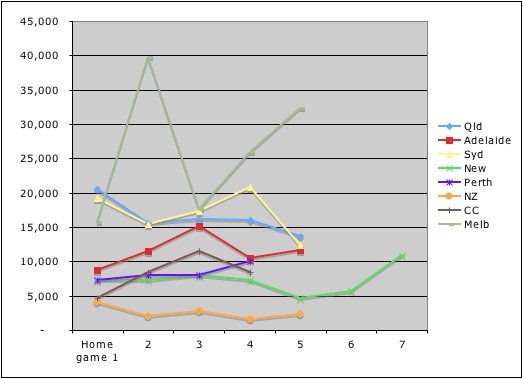
Half the teams in the A-League play ten home games and the other half eleven. After round ten, six teams have played five games at home, Perth and central Coast only four, and Newcastle seven of their ten.
The franchise teams that had ten games last season get eleven this season and vise-versa.
The birth of the A-League had a significant impact on crowd sizes in the first half of last season and in the second half they tapered off a little. The victory against Uruguay and qualification to the world cup had no impact on crowd size.
Clubs are funded by sponsors, club activities (pokies), FFA distribution of Foxtel funding, FFA distribution of FIFA world cup performance funding, shareholders funds, merchandise, and gate-take. The FFA has rigid home ground requirements which, given stadium availability and costs, may advantage some clubs' cost structure over others. As a result, some clubs breakeven point for the home ground is much higher than others. For example, the Queensland Roar has been quoted as requiring 20,000 people to break-even at Lang Park, while clubs in smaller cities may only need 10,000 or less. In any case, reaching breakeven size crowd is key for each team to turn home grounds into positives for A-League and club sustainability. Further, together with the Foxtel audience, the gate take is a critical measure of the success of the A-League .
So how are we doing after round ten of a 21 round competition? Overall, crowds are up 35,252 on the same home fixtures last year. However, that improvement is largely down to the performance of Melbourne. Victory have already attracted 131,417 fans from five home games. This is an increase of 54,155 on its first five home games last year. Clearly, the Melbourne franchise has been a bonanza waiting for the team to hold together a winning streak and promote star players and major match-ups. I predict Melbourne will attract around 250,000 fans this season. Last season it put in 141,632. Sydney attracted 183,355. My prediction would be a great performance for Melbourne and well done to Geoff Lord for hanging in there and to the FFA for backing them last year. Victoria is looking like a great site for a new team next year. I would favour an all under 23 local squad.
Thanks to the grudge match with Melbourne in round nine, Sydney has attracted more fans (5,167) to its first five home matches than last season. Crowds from the first three home games were disappointing and only the 20,881 against Melbourne pulled it out of the negative compared to last season. However, Sydney has been a big contributor to crowds for its away games particularly the 39,730 achieved by Melbourne. And the Carbone appearances also helped the turn out for away games. Overall, Sydney has a long way to go to promote the gate take in NSW.
If the two leading crowd attractors from last season, Sydney (183,473) and Queensland (162,636) could each match Melbourne the future of the A-League would be secure. A range of major potential sponsors could no longer ignore the leading position of football as a participation sport and an expanded division, expanded Asian champions league, and most importantly, dramatically expanded salary cap would be viable. Harry (in a seat next to Joey Johns at Newcastle’s round 10 win) could come home.
No doubt Queensland Roar has the potential to move its crowds from the mid teens, to the twenties and ultimately to fill Lang Park (50,000). Melbourne has shown the way. I expect that Queensland will do what it takes to secure a top four spot this year. Queensland is 6% below last season’s first five rounds crowd. I put this down to a lack of major fixtures so far (it only plays Sydney once and on the last game of the season) and the unfortunate spreading of home games. It now has 4 in the next 6 games. What ever happened to one game at home and one away to build crowd interest? However, I expect the club to do what it takes to keep its average above 15,000 this season.
The smaller clubs from Newcastle, Adelaide and Central Coast all made the finals last season. Central Coast was able to build its crowd up to 12,000 for its last league game last year. While not matching this mark, Central Coast, despite some wet games and loses, have been able to increase its crowd year-on-year for the first four games by 6,000 in total. Adelaide has also increased its crown on last season by over 6,600. However, Newcastle is already down over 11,000 year-on-year for its first six matches. Its good performance this week may prove critical to the shape of its home crowd for the remainder of the season.
Perth is under the management of the FFA. It is 18% down on last year’s crowd for its four games. I feel that last year the home crowd’s expectations were built on the financial advantage that the one WA team had in the National Soccer League, building a powerful winning team. And the results from last year reflected an averaging out of that advantage as all states (bar NSW) were reduced to one team.
What can you say about NZ crowds? They were low last year and lower this year.
Home crowd stats
A-League Version 1
Home game 1 2 3 4 5 6
Qld 20,725 15,444 23,142 13,195
Adel 11,020 8,785 7,013 13,182
Syd 25,208 15,614 18,276 11,836
New 13,160 9,127 7,495 7,436 5,868 9,371
Perth 11,113 8,509 8,052 13,157
NZ 9,827 4,938 3,558 4,182
CC 5,917 5,261 9,313 6,494
Melb 17,960 13,831 11,010 18,260 16,201 13,239
Total 114,930 81,509 87,859 87,742 82,674 76,635
A-League version 2
Home game 1 2 3 4 5 6
Qld 20,606 15,517 16,143 16,061
Adel 8,785 11,474 10,493 11,600
Syd 19,274 15,488 17,274 20,881
New 7,304 7,276 7,961 7,309 4,635 5,725
Perth 7,229 8,052 7,983 9,978
NZ 4,100 2,107 2,764 1,632
CC 4,644 8,439 11,567 8,496
Melb 15,781 39,730 17,617 25,921 32,368
Total 87,723 108,083 91,802 101,878 37,003 5,725
Subscribe to:
Posts (Atom)